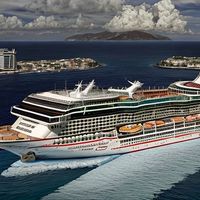
Reveling in the sun-soaked landscapes south of the border may come with a heftier price tag for cruise ship visitors to Mexico starting next year. The Mexican government is set to introduce a $42 immigration surcharge for each passenger arriving via cruise liners.
According to the Associated Press, this fee will be levied on all passengers, irrespective of whether they choose to disembark or remain aboard the vessel. The new legislation mandates that Mexico's Immigration Institute will issue a "group visa to every individual on the ship's manifest." This development has raised concerns among several tourism organizations.
When combined with a $5 per passenger fee imposed by local governments, Mexican ports could become some of the costliest destinations globally, as per the Mexican Association of Naval Agents (AMANAC). In a public statement, the association implored the government to reconsider the rollout of this charge, cautioning that it could diminish the competitiveness of Mexico's cruise industry against more affordable Caribbean alternatives.
Currently, passengers on cruise ships are exempt from immigration fees in Mexico, as they are categorized as being "in transit." The recently approved fee, which has been endorsed by both houses of the Mexican Congress, allocates two-thirds of the revenue to support the Mexican military. The new surcharge is slated to commence on January 1, providing scant time for tourists to accommodate this additional expenditure.
AMANAC has warned in a release that "Mexico could witness a loss of up to 10 million passengers and over 3,300 ship visits in 2025" should the fee be enforced. Mexican President Claudia Sheinbaum has defended the surcharge, asserting that it is not a novel tax but rather an adjustment to existing levies that are indexed to inflation. She also mentioned that ongoing dialogues are taking place among the various agencies that will be impacted by the fee.
Michele Paige, Chief Executive Officer of the Florida-Caribbean Cruise Association—a trade organization representing vessels sailing in the United States, Latin America, and the Caribbean—indicated that most cruises scheduled for 2025 have already been fully paid for, and companies may be disinclined to direct their passengers to locations that impose unanticipated charges. “We acknowledge President Sheinbaum’s assurance during her December 4 press conference that the transition will be gradual and that she has directed federal officials to collaborate with our sector, but thus far, we have not received any communication,” Paige stated in a press release sent on Thursday.
Sergio Gonzales Rubiera, President of The Travel Agents Association in Cozumel, Mexico’s principal cruise destination and one of the world’s most frequented ports, is not overly concerned about the new fee. He suggested that while some cruise lines might opt to bypass Mexican ports in protest, the majority are likely to incorporate the fee into the cost of future voyages. His primary lament is that the federal government will retain the majority of the funds instead of channeling them towards assisting local communities. Former President Andres Manuel Lopez Obrador has expanded the role of the Mexican armed forces, which now oversee the construction of numerous infrastructure projects, including El Tren Maya—a network of new railway routes linking several tourist hotspots in southeastern Mexico.
As the Mexican government prepares to implement the new immigration fee for cruise ship passengers, the potential repercussions for the tourism industry are a topic of heated debate. The $42 charge, which is set to be applied to every passenger on a cruise ship that makes a stop in Mexico, has sparked a wave of apprehension among tourism stakeholders. This fee, which is independent of whether passengers decide to set foot on Mexican soil or remain on board, is expected to be issued as a collective visa by Mexico’s Immigration Institute for all individuals listed on the ship’s manifest.
The introduction of this fee, coupled with an additional $5 fee levied by local states, could position Mexican destinations as some of the priciest in the global tourism market, according to the Mexican Association of Naval Agents (AMANAC). In an official statement, AMANAC has urged the government to re-evaluate the implementation of this charge, warning that it could negatively impact Mexico’s competitiveness against other Caribbean destinations that are more cost-effective for visitors. Currently, cruise ship passengers are not required to pay Mexico’s immigration fees, as they are considered to be in transit.
The fee, which has been approved by both chambers of the Mexican Congress, is designed to allocate two-thirds of the revenue to finance the Mexican army. With the new charge set to take effect on January 1, there is limited time for tourists to adapt to this additional cost. AMANAC has warned in a release that "Mexico could lose up to 10 million passengers and more than 3,300 ship calls in 2025" if the fee is implemented. Mexican President Claudia Sheinbaum has defended the fee, insisting it is not a new tax but is only an adjustment to existing charges that she said are tied to inflation. She also mentioned that ongoing dialogues are taking place among the various agencies that will be impacted by the fee.
Michele Paige, CEO of the Florida-Caribbean Cruise Association, a trade group representing vessels operating in the United States, Latin America, and the Caribbean, says that most of the cruises booked for 2025 are already paid for and the companies might be reluctant to take their passengers to places that impose unexpected fees. “We appreciate President Sheinbaum’s assurance during her Wednesday [December 4] news conference that the change will happen slowly and that she’s instructed federal officials to work with our industry, but we haven’t heard from anyone yet,” said Paige in a news release sent on Thursday.
Sergio Gonzales Rubiera, President of The Travel Agents Association in Cozumel, Mexico’s main cruise destination and one of the most visited ports in the world, is not yet alarmed over the new fee. He says that some cruise lines might skip Mexican ports in protest, but he thinks most will include the fee in the price of future trips. What he laments is that the federal government will keep most of the money instead of helping local communities.
Former President Andres Manuel Lopez Obrador expanded the role of the Mexican armed forces that now oversee the construction of many infrastructure projects such as El Tren Maya, a series of new train routes connecting some of southeastern Mexico’s tourist destinations.
In the verdant hills of Negros Occidental, amidst the Philippines' emerald highlands, there stands an edifice that is as whimsical as it is colossal. This is no ordinary structure; it is the world's largest chicken-shaped building, a testament to the imagination and the indomitable spirit of its creator, Ricardo Cano Gwapo Tan. A septuagenarian with a heart as vast as the sky and a playful twinkle in his eye, Tan has crafted a legacy that is as grand as it is peculiar, a six-story, 35-meter high homage to the humble chicken.
Perched atop the Campuestohan Highland Resort, this architectural marvel is not merely a tribute to avian architecture but a monument to the significance of the game fowl industry in the region. With 15 rooms, each equipped with air-conditioning for comfort though windowless to maintain the illusion of feathers, this chicken-shaped sanctuary was officially awarded the Guinness World Record title on September 8th. It is a feat of engineering and a triumph of vision, a structure that has captured the hearts and imaginations of people around the globe.
Tan, a former local politician, describes himself as a "big kid at heart," and it is this childlike wonder that has driven him to create something with a "wow factor." His resort is his canvas, and the chicken-shaped hotel is his masterpiece, a testament to the power of creativity and the joy of play. It is a structure that defies convention, a building that turns heads and sparks smiles, a place where the mundane is transformed into the extraordinary.
The chicken holds a special place in the hearts of the people of Negros. Cockfighting, or "sabong," is a tradition that predates Spanish colonial rule and remains a popular pastime in rural areas of the Philippines, Thailand, and Indonesia. Despite being banned in India and facing opposition from animal rights groups, the sport continues to thrive, generating millions of pesos in cockfighting arenas across the Philippines. Tan, recognizing the economic and cultural importance of the game fowl industry, dedicated his building to this billion-peso empire, a source of pride and honor for the province.
The chicken is more than just a symbol of sport and industry; it is a creature of dualities, embodying both calmness and command. As a child, Tan recalls the rooster's crow during the Christmas season, a call for families to gather for Misa de Gallo, the "Rooster's Mass," a series of dawn masses leading up to Christmas. This tradition is deeply ingrained in the culture of the Philippines, and the resort's rooster-shaped hotel is a fitting tribute to this time-honored custom. It is no surprise that the hotel is fully booked for the holiday season, with families planning to stay through the end of January 2025.
The cost of a room in this unique hotel is a modest $80 for four people, and for a larger room accommodating up to seven, the price is about $120. These are not just rooms, but experiences, opportunities to immerse oneself in the culture and the character of the region. The resort, once a tranquil mountaintop purchased by Tan's wife, Anita, has been transformed into a five-hectare wonderland, replete with two massive wave pools, a restaurant, a café, and hundreds of dinosaur and cartoon statues that entertain and delight guests of all ages.
Access to this colossal rooster is an adventure in itself. Travelers must embark on a journey that begins with a domestic flight from Manila or Cebu to the Bacolod-Silay International Airport in Negros Occidental, part of the archipelagic country's over 7,000 islands. From there, it is a 17-mile drive through the lush farmland and an uphill climb to reach the giant rooster, a beacon of innovation and a symbol of the Philippines' rich heritage.
The chicken-shaped building is more than just a novelty; it is a symbol of the Philippines' creativity and resilience. It stands as a reminder that even in a world of conformity, there is room for the extraordinary, for the unexpected, for the absurd. It is a structure that invites us to think differently, to see the world through the eyes of a child, to find joy in the most unlikely of places.
As we gaze upon this colossal chicken, we are reminded of the power of dreams and the importance of leaving a legacy. Tan's vision has turned a simple mountaintop into a destination, a place where the ordinary becomes the extraordinary, where the mundane is elevated to the magical. This chicken is not just a building; it is a testament to the human spirit, a symbol of the power of imagination, and a reminder that even the most outlandish ideas can take flight and soar to great heights.
In a world that often takes itself too seriously, the giant chicken of Negros Occidental offers a refreshing perspective. It is a place where the absurd is celebrated, where the unconventional is embraced, and where the impossible becomes possible. It is a monument to the power of dreams, a tribute to the resilience of the human spirit, and a reminder that even in the most unlikely of places, greatness can be found.
As we conclude our journey to this remarkable destination, we are left with a sense of awe and a heart full of wonder. The giant chicken of the Philippines is more than just a building; it is a testament to the power of imagination, a symbol of the human spirit, and a reminder that even the most outlandish ideas can take flight and soar to great heights. It is a place where the ordinary becomes the extraordinary, where the mundane is elevated to the magical, and where the impossible becomes possible. It is a monument to the power of dreams, a tribute to the resilience of the human spirit, and a reminder that even in the most unlikely of places, greatness can be found.
By John Smith/Dec 12, 2024

By Olivia Reed/Dec 12, 2024
By Michael Brown/Dec 12, 2024

By Amanda Phillips/Dec 12, 2024

By Lily Simpson/Dec 12, 2024

By Benjamin Evans/Dec 12, 2024

By Emma Thompson/Dec 12, 2024

By Michael Brown/Dec 12, 2024

By Thomas Roberts/Dec 12, 2024

By Elizabeth Taylor/Dec 12, 2024

By Michael Brown/Dec 2, 2024

By Sarah Davis/Dec 2, 2024

By George Bailey/Dec 2, 2024
By Joshua Howard/Dec 2, 2024

By James Moore/Dec 2, 2024
By Victoria Gonzalez/Dec 2, 2024
By Emily Johnson/Dec 2, 2024

By Daniel Scott/Dec 2, 2024

By Emma Thompson/Dec 2, 2024
By Benjamin Evans/Dec 2, 2024