The Australian outback, a vast expanse of deserts and semi-arid wilderness, is a testament to the untamed beauty of our planet. It is a land that covers approximately 80% of Australia's interior, an area so immense it could swallow Texas seven times over. Here, the elements are unyielding, with temperatures swinging wildly between day and night, and the landscape is so inhospitable that it is largely forsaken by mankind.
Yet, within this wilderness lies a treasure trove of natural wonders, from the expansive blue skies that seem to stretch on forever to sunsets that paint the horizon for what feels like an eternity, offering some of the most breathtaking scenes on Earth.
For those who seek to delve into the heart of this wild land, the outback presents a conundrum: how to explore without forsaking the comforts of civilization? The answer lies in the rails of The Ghan, a luxury sleeper train that offers a journey of a lifetime from the comfort of its air-conditioned carriages. Spanning an impressive 1,851 miles (2,979 kilometers) and traversing multiple climate zones, The Ghan is one of the world's longest train journeys, connecting the tropical north of Darwin to the lush, rolling hills of Adelaide on the southern coast.
Operating twice weekly in either direction and running year-round except for the sweltering summer months of the southern hemisphere, The Ghan is more than just a mode of transport; it is a floating resort on rails, offering a slow, majestic cruise through the heart of Australia. With top speeds reaching 71 miles (115 kilometers) per hour, the train could, in theory, complete the journey in a day and a half. However, The Ghan is not about haste; it is about the journey, with extended stops and guided excursions that allow passengers to immerse themselves in the rich tapestry of Australia's landscape and culture.
The Ghan is not a mere train; it is a window to the soul of Australia, offering passengers a glimpse into the country's aboriginal history and culture, as well as the struggles faced by European settlers in the 19th century. As the train winds its way through the outback, it stops at small towns that offer unique insights into a past that is both rich and challenging. These settlements, often hundreds of miles away from any major city, are a testament to the resilience of the human spirit in the face of an unforgiving environment.
For those who prefer not to "rough it," The Ghan offers a luxurious alternative, allowing travelers to experience the region's rugged beauty and heritage without lifting a finger. This train is a highly rated bucket-list adventure for many, including Australians themselves. Rhyll Woodall and her husband, for instance, had dreamed of a vacation on The Ghan for a decade, a dream that was sparked by their first glimpse of the outback from an airplane window.
The Ghan Expedition, a southbound, three-night journey, is the longest run possible and departs from Darwin, stopping in Katherine, Alice Springs, and Coober Pedy before arriving in Adelaide on the fourth day, some 75 hours later. On any given day, The Ghan is one of the longest passenger trains in the world, with its length spanning over 900 meters (more than half a mile), its carriages coupling and decoupling like a living organism depending on the number of guest bookings.
Passengers can choose between two service classes: platinum and gold. Platinum, the more expensive option, offers larger cabins and a private dining carriage, while gold class, the most popular choice, provides single rooms for solo travelers and twin cabins for couples, complete with en suite bathrooms and plush lounge seats that convert into bunk beds at night.
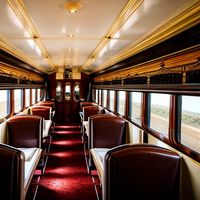
Everything about The Ghan is designed to evoke the romance of the golden age of rail travel. The older gold cabins, with their brass fixtures, warm earth-tone interiors, and walnut wood wall paneling, offer a vintage experience that is both charming and nostalgic. It feels like riding in a fancy, slightly cramped, and aging hotel on wheels, a testament to a bygone era of travel.
The Ghan is not cheap, with the price of a double occupancy cabin in gold class starting at around $2,800 per person for three nights on "The Ghan Expedition," and platinum class starting at more than $4,900 per person for the same journey. However, the cost includes food and drinks onboard, even alcohol, which is one reason the bar car, dubbed the Explorer’s Lounge, is always full.
The food is a highlight of any Ghan ride, with most passengers dining at the Queen Adelaide restaurant, a carriage with Art Deco design accents and linen-topped tables. Meals are a multi-course affair, with a menu that changes daily and is inspired by the outback regions the train passes through, offering dishes such as kangaroo loin, grilled saltwater barramundi, and crocodile dumplings.
Onboard Wi-Fi is available, but like mobile coverage along the route, it is unavailable in the most remote sections of the outback, which is virtually the entire trip. This lack of screen time makes The Ghan feel even more like a nostalgic throwback to a simpler era, where conversation and camaraderie take center stage.
For thrill-seekers, be forewarned: there's nothing physically taxing about this long journey. The excursions offer a good chance to stretch your legs, but don't expect to break a sweat. This may be by design, as most travelers on The Ghan are in their 60s and 70s, according to Thomas Borthwick, the guest relations manager for Journey Beyond, the company that operates the train.
Despite the price tag, demand for The Ghan is incredibly high, with many passengers booking their reservations months, sometimes years, in advance. Many riders are train enthusiasts hoping to learn more about the role of the railways in the early exploration and development of Australia's vast interior.
The Ghan began traveling between Adelaide and Alice Springs in 1929, and the track was expanded to Darwin in 2004, creating Australia's first north-south transcontinental railway link. Its name is an abbreviation of "Afghanistan," in recognition of South Asian immigrants who moved to Australia in the 1800s. Many of them brought camels, which Australia desperately needed to venture deeper into the remote outback. Australia's immigrant cameleers were pioneers of outback exploration, helping construct roads and railway lines, including early tracks that made the current route of The Ghan possible.
The Ghan's logo still features a single-humped camel and cameleer, a nod to its historical roots. For Graham Dadleh, one of the two drivers who take turns at the helm over the course of The Ghan's three-night journey, the train holds a special place in his heart. His great-grandfather was an Afghan immigrant who came to Australia with camels, and his family's connection to the outback runs deep.
These days, Dadleh spends much of his time in the locomotive trying to avoid camels, as Australia has an estimated one million feral camels still roaming throughout the deserts of the outback. Fortunately, we did not encounter any on our journey, and by early afternoon on the fourth day, The Ghan rolls into Adelaide's train terminal for its final stop.
Traveling through the wilds of Australia's outback is, for most passengers, the trip of a lifetime. For Dadleh, it's just another day in the office — not that it ever gets old. "Nothing is ever the same from trip to trip. The weather patterns, wildlife, the night skies," Dadleh said. "It's one of the best offices you can work in." And so, The Ghan continues its journey, a symbol of Australia's past and a gateway to its untamed heart.
As we stand on the precipice of 2025, the financial world is bracing for a tumultuous year, with currency markets expected to experience significant volatility. According to a recent analysis by KKR, a leading global investment firm, the coming year is poised to see a "steep" market correction, largely driven by erratic currency fluctuations. This forecast is based on a confluence of factors, including escalating trade disputes, fiscal instability, and rising geopolitical tensions, all of which are set to amplify foreign exchange (FX) volatility beyond recent historical norms.
Historically, currency-related anxieties have been known to trigger market downturns, as evidenced by the late 1990s. During that period, the Asian financial crisis and the Russian debt default sent shockwaves through global markets, leading to significant currency devaluations and a subsequent bear market. The parallels between those events and the current economic landscape are striking, and KKR cautions investors against underestimating the potential impact of erratic currency movements on the ongoing bull market.
In its 2025 market outlook, KKR highlights that currency fluctuations could become the market's "Achilles' heel," suggesting that this is not an opportune time to take on excessive FX risk. The firm advises investors to prepare for trade wars and growing fiscal imbalances, which are likely to exacerbate FX volatility. Tariffs, for instance, are expected to disrupt global interest rate coordination, leading to further economic friction and instability. As countries engage in tit-for-tat trade measures, the resulting uncertainty can cause investors to flee from riskier assets, leading to sharp declines in currency values.
Monetary policy also plays a crucial role in determining currency values, and significant shifts can lead to market disruptions. Central banks around the world are grappling with the challenge of balancing inflationary pressures with the need to support economic growth. Any missteps in this delicate balancing act can have far-reaching consequences for currency markets. For example, if a central bank raises interest rates too aggressively, it can lead to a rapid appreciation of the domestic currency, making exports less competitive and potentially triggering a recession. Conversely, if a central bank is perceived as being too dovish, it can lead to currency depreciation and inflationary pressures.
Additionally, high levels of government debt can diminish the demand for a nation's currency, potentially resulting in devaluations. As countries continue to grapple with the aftermath of the COVID-19 pandemic, many have amassed significant debt burdens. This has raised concerns about the sustainability of government finances and the potential for default. Investors may become increasingly wary of holding currencies that are backed by heavily indebted governments, leading to capital outflows and currency depreciation.
To better understand the potential implications of these currency fluctuations, KKR encourages investors to reflect on the market dynamics between 1994 and 2000. Following interest rate increases that initially unsettled markets in 1994, stock markets experienced a rally, mirroring the recovery seen since 2022, as noted by KKR. However, the outlook warns that the situation became precarious in 1998, when a combination of currency unwinds and excessive leverage led to a brief but sharp market correction that investors had underestimated. The lessons from this period underscore the importance of being vigilant about currency risks and the potential for sudden market shifts.
Early signs of this phenomenon can already be observed in certain markets. For instance, debt and stock markets in Brazil have been experiencing turbulence this week due to a dramatic decline in the country's real currency. The real has become the worst-performing currency against the US dollar, reaching a record low on Wednesday. Brazilians have been selling off the real since late November, following the failure of proposed austerity measures to appease investors concerned about the country's expanding fiscal deficit. This situation serves as a cautionary tale for investors, highlighting the potential consequences of currency instability on broader financial markets.
Despite these concerns, KKR maintains a largely optimistic outlook for 2025. The firm predicts that the S&P 500 index will reach 6,850 by the end of the year, with a further surge towards 7,500 anticipated in 2026. This bullish forecast is based on several factors, including strong corporate earnings growth, continued economic expansion, and the potential for technological advancements to drive innovation and productivity gains. However, KKR acknowledges that there will be considerable volatility, consolidations, and drawdowns along the way to their 2025-26 price targets.
To navigate this complex landscape, KKR suggests that investors diversify their portfolios by combining exposure to mega-cap technology stocks with cyclical investments, as well as small and mid-cap equities. Mega-cap technology stocks have historically provided a degree of stability and growth potential, given their dominant market positions and robust cash flows. Meanwhile, cyclical investments can offer attractive returns during periods of economic expansion, as they tend to benefit from rising demand for goods and services. Small and mid-cap equities, on the other hand, can provide opportunities for growth and diversification, as they often have greater potential for innovation and expansion compared to their larger counterparts.
In conclusion, as we approach 2025, investors must remain vigilant about the potential risks posed by currency fluctuations and the broader economic landscape. By taking a proactive and diversified approach to portfolio management, investors can better position themselves to weather the storms ahead and capitalize on the opportunities that may arise. For a more detailed understanding of KKR's 2025 market predictions and the potential implications for global financial markets, investors are encouraged to read the original article on Business Insider, which delves deeper into the intricacies of the firm's analysis and offers valuable insights for navigating the year ahead.
By John Smith/Dec 12, 2024
By Olivia Reed/Dec 12, 2024

By Michael Brown/Dec 12, 2024

By Amanda Phillips/Dec 12, 2024

By Lily Simpson/Dec 12, 2024

By Benjamin Evans/Dec 12, 2024
By Emma Thompson/Dec 12, 2024

By Michael Brown/Dec 12, 2024

By Thomas Roberts/Dec 12, 2024

By Elizabeth Taylor/Dec 12, 2024

By Michael Brown/Dec 2, 2024
By Sarah Davis/Dec 2, 2024

By George Bailey/Dec 2, 2024
By Joshua Howard/Dec 2, 2024

By James Moore/Dec 2, 2024
By Victoria Gonzalez/Dec 2, 2024
By Emily Johnson/Dec 2, 2024

By Daniel Scott/Dec 2, 2024

By Emma Thompson/Dec 2, 2024

By Benjamin Evans/Dec 2, 2024