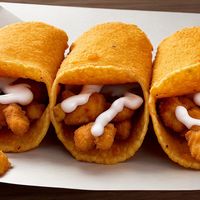
Taco Bell, known for its Mexican-inspired dishes, is making a slight detour into all-American territory with its latest menu addition. Starting from Thursday, the fast-food chain will introduce chicken nuggets for a limited period. However, these nuggets come with a distinctive Taco Bell twist: they are marinated in a zesty jalapeño buttermilk blend, then coated with a mix of tortilla chips and breadcrumbs, offering a unique and flavorful take on the classic fast-food item.
This move marks Taco Bell's strategic entry into the competitive chicken nugget market, dominated by giants like McDonald's, Wendy's, and Chick-Fil-A. The introduction of these new nuggets is not just a menu expansion but a calculated response to shifting consumer preferences, particularly among younger generations who are increasingly favoring chicken over red meat.
In a press release, Taco Bell acknowledged its entry into a fiercely competitive market where customer loyalty for chicken nuggets is well-established, with major players like McDonald's, Wendy's, and Chick-Fil-A dominating the scene. This move is part of Taco Bell's strategy to diversify its poultry offerings, as younger consumers increasingly prefer chicken to red meat.
The fast-food industry is highly competitive, with each major player vying for market share. Taco Bell's entry into the chicken nugget arena is a bold step, aiming to carve out a niche by offering a unique flavor profile that differentiates it from the standard offerings of competitors. The use of jalapeño buttermilk for marinating and the incorporation of tortilla chips and breadcrumbs for coating are examples of how Taco Bell is infusing its signature flavors into a traditional fast-food item.
Former CEO Mark King highlighted this shift last year, stating that "a large percentage of our business is beef, and the Gen Z consumer wants chicken." This statement underscores a broader trend in consumer preferences, particularly among younger demographics who are driving demand for chicken-based products.
The demand for chicken-based items has been on the rise, driven by health-conscious consumers and those seeking variety in their fast-food choices. Taco Bell's response to this trend is part of a larger industry movement towards menu diversification and innovation to meet evolving customer tastes.
In line with this consumer trend, Taco Bell launched the "Cantina Chicken Menu" in March, featuring oven-roasted, shredded chicken in a variety of dishes such as tacos and salads. This innovation contributed to a 5% increase in sales at Taco Bell locations open for at least a year during the quarter following the new menu's introduction, with approximately one in four orders including an item from the "Chicken Cantina Menu."
The success of the "Cantina Chicken Menu" demonstrated Taco Bell's ability to adapt to changing market conditions and consumer preferences. By building on this success, the chain aims to further solidify its position in the fast-food industry through continued innovation and menu expansion.
To further cater to the adventurous palates of Gen-Z diners, Taco Bell is also adding new dips and sauces to its menu. These include the chain's new tangy signature dip, Bell Sauce; a honey mustard sauce infused with jalapeño; and a spicy ranch sauce created in collaboration with Hidden Valley.
These new additions to the menu are designed to complement the chicken nuggets and provide customers with a variety of flavor combinations to choose from. The introduction of these sauces reflects Taco Bell's commitment to enhancing the dining experience through flavor innovation, a key driver of customer satisfaction and loyalty.
The prices for these chicken nuggets vary by location, with Taco Bell suggesting a retail price of $3.99 for a serving of five nuggets with one sauce and $6.99 for ten nuggets with two sauces. Additionally, a value meal priced at $10.49 will be offered, consisting of five nuggets, one sauce, a crunchy taco, a beef chalupa, nacho fries, and a medium soda.
Taco Bell's pricing strategy aims to be competitive while offering value to customers. The various pricing options allow customers to choose according to their appetite and budget, ensuring broad market appeal. The value meal, in particular, offers a comprehensive dining experience at an affordable price point, encouraging customers to try multiple menu items.
The last time Taco Bell offered a product similar to chicken nuggets was back in 2017 with the "Naked Chicken Chips," which was also a limited-time offer. This historical context shows Taco Bell's pattern of introducing innovative chicken-based items as limited-time offers, likely to test market reception before considering permanent menu additions.
The "Naked Chicken Chips" garnered attention and interest from customers, indicating a existing demand for chicken products at Taco Bell. The return to chicken-based items with the new nuggets suggests that Taco Bell sees continued potential in this market segment and is committed to exploring innovative ways to meet the changing tastes of its customers.
This strategic pivot towards chicken-based items reflects Taco Bell's commitment to meeting the evolving tastes and preferences of its customer base. By offering a new take on a beloved American staple, the chain is not only expanding its menu but also positioning itself to attract a new demographic that values variety and innovation in their fast-food choices.
The use of jalapeño buttermilk for marinating and the incorporation of tortilla chips and breadcrumbs for coating are examples of how Taco Bell is infusing its signature flavors into a traditional fast-food item, thereby differentiating itself from competitors. This approach allows Taco Bell to leverage its brand identity while entering a new market segment.
Taco Bell's introduction of chicken nuggets is a strategic move that aligns with the preferences of younger consumers and the broader trends in the fast-food industry. By offering a distinctive take on a popular item, the chain is not only expanding its menu but also solidifying its position as a leader in fast-food innovation. The new chicken nuggets, along with the "Cantina Chicken Menu" and the array of new dips and sauces, demonstrate Taco Bell's ability to adapt and evolve, ensuring that it remains relevant and appealing to its diverse customer base
Nearly five decades after the tragic events that unfolded in Guyana, the nation is considering revisiting its somber past. The United States' Reverend Jim Jones and over 900 of his followers perished in the remote interior of this South American nation, marking one of the most significant acts of mass suicide in modern history. A government-supported tour company is now proposing to open the former commune, now hidden by lush vegetation, to tourists, a move that has reignited old wounds. Critics argue that such a venture would show disrespect to the victims and unearth a distressing chapter of history.
Jordan Vilchez, who was relocated to the Peoples Temple commune at the age of 14 after growing up in California, shared her ambivalent feelings about the proposed tour with The Associated Press in a phone call from the United States. She was in the capital of Guyana on the day Jones commanded hundreds of his followers to consume a poisoned, grape-flavored beverage, which was administered to the children first.
Among the casualties were her two sisters and two nephews. "I narrowly escaped death by a single day," she reflected. Vilchez, now 67, stated that Guyana has the right to capitalize on any initiatives related to Jonestown. However, she also expressed that "any situation where individuals were coerced into their demise should be approached with reverence." She hopes that the tour operator will provide historical context and explain the reasons why so many people traveled to Guyana with the belief that they were seeking a better life.
The tour is set to transport visitors to the remote village of Port Kaituma, nestled within the verdant jungles of northern Guyana. Accessible only by boat, helicopter, or plane, as rivers serve as the primary means of traversing Guyana's interior, the journey to the abandoned commune and former agricultural settlement is an additional six miles along a rough, overgrown dirt path. Neville Bissember, a law professor at the University of Guyana, has questioned the proposed tour, describing it as a "macabre and peculiar" concept in a letter that was recently published. "What aspect of Guyana's natural beauty and cultural heritage is represented in a location where mass suicide and other atrocities and human rights abuses were inflicted upon a group of American citizens, who had no connection to Guyana or its people?" he wrote.
Despite ongoing criticism, the tour has garnered strong support from the government's Tourism Authority and Guyana's Tourism and Hospitality Association. Tourism Minister Oneidge Walrond informed the AP that the government is backing the initiative at Jonestown but is cognizant of "some level of resistance" from certain segments of society. She mentioned that the government has already assisted in clearing the area "to ensure that a superior product can be marketed," and added that the tour might require approval from the Cabinet. "It certainly has my backing," she stated. "It is feasible. After all, we have witnessed how Rwanda has managed that terrible tragedy as a precedent."
Rose Sewcharran, the director of Wonderlust Adventures, the private tour operator planning to take visitors to Jonestown, expressed that she is encouraged by the support. "We believe it is high time," she said. "This occurs globally. We have numerous examples of dark, macabre tourism around the world, including Auschwitz and the Holocaust museum."
The mass suicide-murder in November 1978 was synonymous with Guyana for many years until vast reserves of oil and gas were discovered off the country's coast nearly a decade ago, transforming it into one of the world's largest offshore oil producers. New roads, schools, and hotels are being constructed across the capital, Georgetown, and beyond, and a nation that rarely saw tourists is now looking to attract more visitors. An obvious draw is Jonestown, argued Astill Paul, the co-pilot of a twin-engine plane that transported U.S. Representative Leo J. Ryan of California and a U.S. news crew to a village near the commune a day before the hundreds of deaths on November 18, 1978. He witnessed gunmen fatally shoot Ryan and four others as they attempted to board the plane on November 18 to return to the capital.
Paul told the AP that he believes the former commune should be developed as a heritage site. "I sat on the tourism board years ago and suggested we do this, but the minister at the time dismissed the idea because the government wanted nothing to do with macabre tourism," he recalled. Until recently, successive governments have avoided Jonestown, arguing that the country's image was severely damaged by the mass murder-suicide, even though only a few Indigenous individuals perished. The vast majority of victims were Americans like Vilchez who traveled to Guyana to follow Jones. Many endured beatings, forced labor, imprisonment, and rehearsals for mass suicide.
Those in favor of a tour include Gerry Gouveia, a pilot who also flew during the time Jonestown was active. "The area should be reconstructed solely for tourists to gain a firsthand understanding of its layout and the events that transpired," he said. "We should reconstruct Jim Jones's home, the main pavilion, and other structures that were present there." Today, all that remains are fragments of a cassava mill, parts of the main pavilion, and a rusted tractor that once pulled a flatbed trailer to transport temple members to the Port Kaituma airfield.
An Offering to the Land
Until now, most visitors to Jonestown have been journalists and family members of the deceased. Organizing an expedition independently is a daunting task: the area is far from the capital and difficult to access, and some consider the closest populated settlement to be perilous. "It's still a very, very, very rugged area," said Fielding McGehee, co-director of The Jonestown Institute, a non-profit organization.
"I don't see how this is going to be an economically viable project because of the substantial funds it would require to transform it into a viable place to visit." McGehee warned against relying on supposed witnesses who will be part of the tour. He said that the memories and stories that have been passed down through generations might not be accurate. "It's almost like a game of telephone," he said. "It does not assist anyone in understanding what happened in Jonestown."
He recalled how one survivor had proposed a personal project to develop the abandoned site, but those from the temple community questioned, 'Why do you want to do that?' McGehee noted that dark tourism is popular, and that visiting Jonestown means tourists could claim they visited a place where over 900 people died on the same day. "It's the prurient interest in tragedy," he said.
If the tour eventually commences, not everything will be visible to tourists. When Vilchez returned to Guyana in 2018 for the first time since the mass suicide-murder, she made an offering to the land upon her arrival in Jonestown. Among the items she buried in the abandoned commune where her sisters and nephews perished were strands of hair from her mother and father, who did not go to Jonestown. "It just felt like a gesture that honored the people that died," she said.

By Laura Wilson/Dec 20, 2024

By Samuel Cooper/Dec 20, 2024

By Daniel Scott/Dec 20, 2024

By Christopher Harris/Dec 20, 2024

By Megan Clark/Dec 20, 2024

By Elizabeth Taylor/Dec 20, 2024
By Ryan Martin/Dec 20, 2024

By Rebecca Stewart/Dec 20, 2024

By David Anderson/Dec 20, 2024

By Samuel Cooper/Dec 20, 2024

By Jessica Lee/Dec 19, 2024

By Joshua Howard/Dec 19, 2024
By Michael Brown/Dec 19, 2024

By Laura Wilson/Dec 19, 2024

By Elizabeth Taylor/Dec 19, 2024

By Ryan Martin/Dec 19, 2024

By Natalie Campbell/Dec 19, 2024
By Samuel Cooper/Dec 19, 2024

By Amanda Phillips/Dec 19, 2024
By Joshua Howard/Dec 19, 2024